( Living soil. Moving water. )
Research
Follow the water. Look inside the soil. Meet the research behind the story.
Study 01 / Soil moisture & precipitation
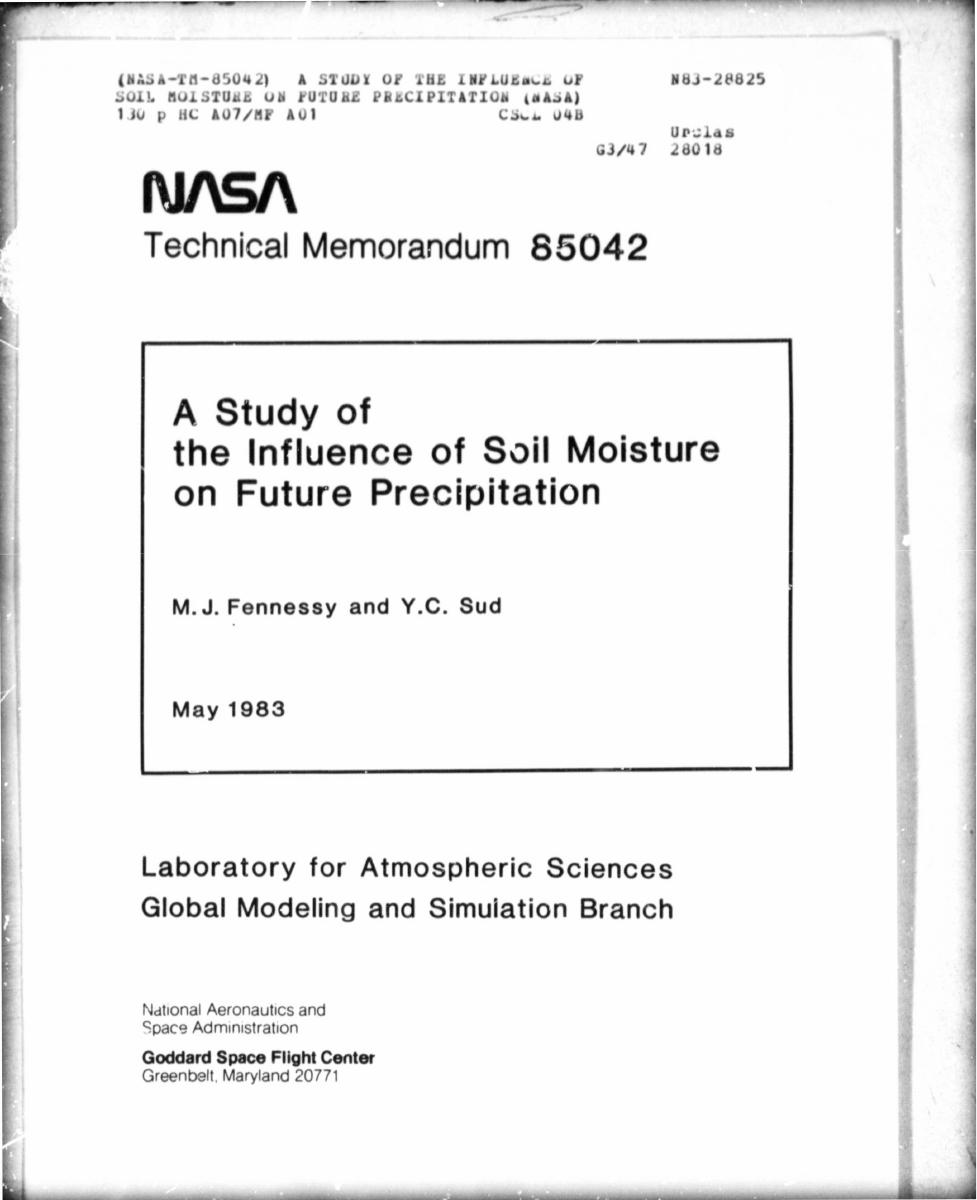
A Study of the Influence of Soil Moisture on Future Precipitation
Authors: M. J. Fennessy & Y. C. Sud
Institution: NASA Goddard Space Flight Center, Laboratory for Atmospheric Sciences, Global Modeling and Simulation Branch
Publication: Technical Memorandum 85042 · May 1983 · Technical report
Using forty years of precipitation and temperature observations from 261 stations across the contiguous United States, the authors modeled soil moisture and investigated its relationship with subsequent rainfall.
Read the full paperPDF · 125 pages · 8.7 MB
What the study found
The report identified positive relationships between earlier soil moisture and later precipitation in some regions, most notably the drought-prone western Great Plains in late summer.
Why it matters
Four decades of American weather data point to a hopeful insight: the ground beneath our feet helps shape the sky above it. Where soil holds moisture, the land keeps talking to the clouds—and the rain keeps answering.
Citation & source notes
Fennessy, M. J., & Sud, Y. C. (1983). A Study of the Influence of Soil Moisture on Future Precipitation. NASA Technical Memorandum 85042. Goddard Space Flight Center.
The full original scan is provided here. Some pages and figures have limited legibility, as noted in the document’s reproduction disclaimer. Inclusion does not imply NASA endorsement of Rain Dance.
( 82 studies · one answer )
Biochar makes
soil hold more water.
Researchers pooled a decade of biochar experiments (2010–2019) into one meta-analysis. Across every soil type, biochar raised the water plants can actually drink. The thirstier the soil, the bigger the gain.
Increase in plant-available water with biochar
+51%
water held at field capacity in sandy soil
−9%
soil bulk density—looser ground that lets water in
82
peer-reviewed studies analyzed
Fatemeh Razzaghi, Peter Bilson Obour & Emmanuel Arthur · “Does biochar improve soil water retention? A systematic review and meta-analysis” · Geoderma 361, 114055 (2020). Shiraz University, Aarhus University & University of Illinois Urbana-Champaign. Figures reported from the published abstract.
( Living cover )
Clover catches the rain.
Roots let it in.
Legumes like crimson clover shield the ground from pounding rain, slow runoff, and open the soil with living roots—so more water soaks in and stays.
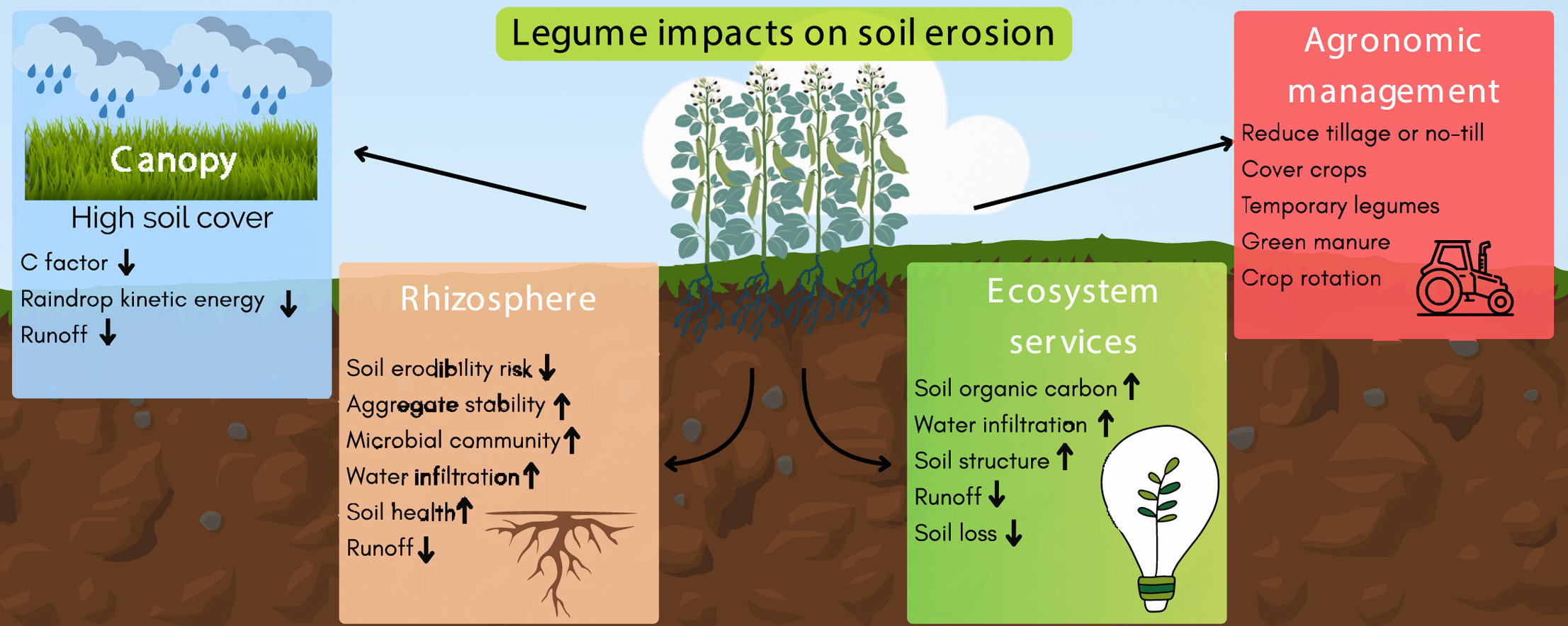
More infiltration. Less runoff.
Canopy softens every raindrop. Roots build structure, feed soil life, and raise infiltration. The result: healthier soil and far less water and topsoil lost down the street.
Published by Elsevier. Reproduced unchanged under CC BY 4.0.
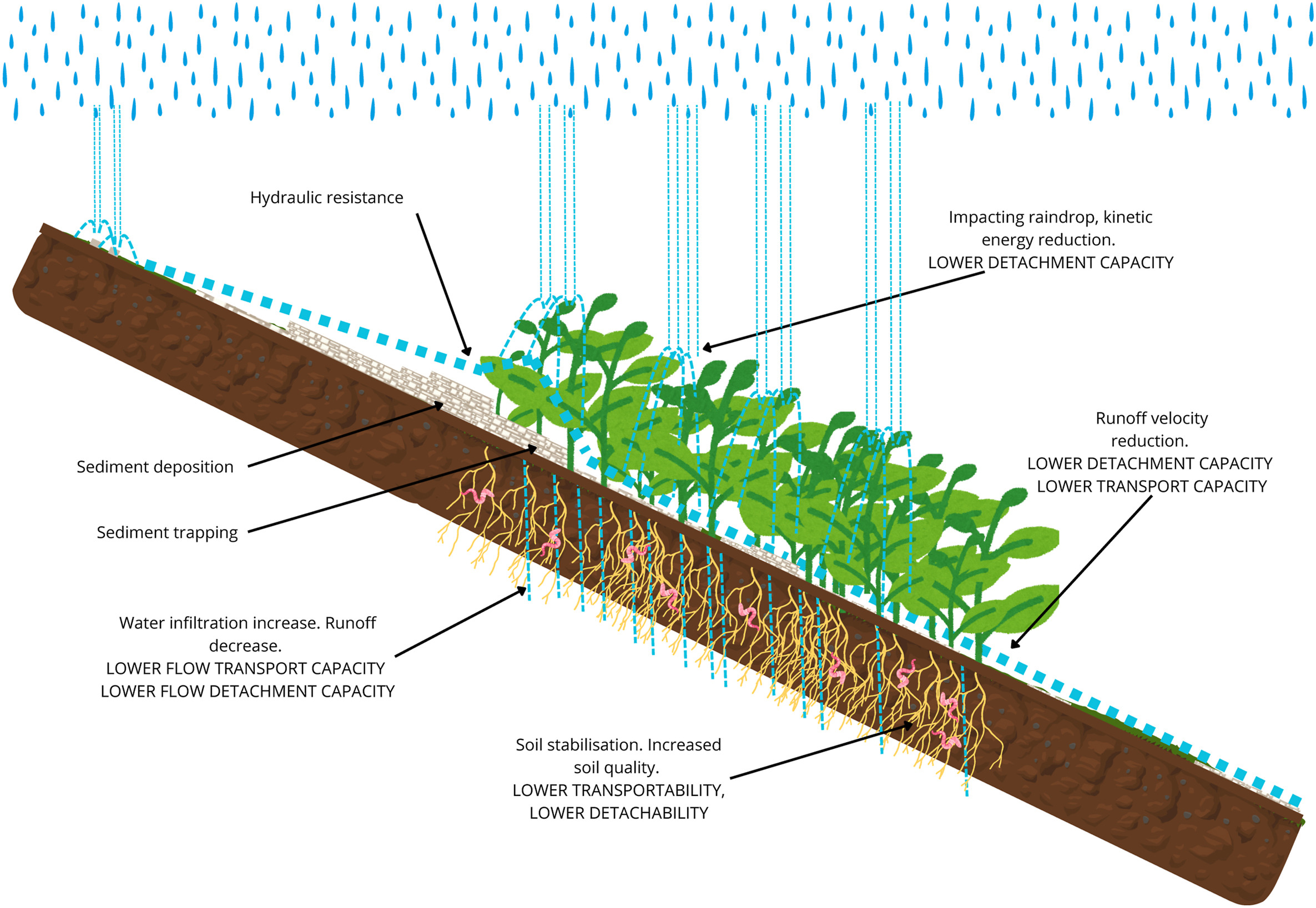
Bare ground vs. living ground
Where roots grow, water follows.
On bare soil, rain races across the surface. Where plants and roots take hold, runoff slows, sediment stays put, and water travels down along the roots into the ground.
( A changing American landscape )
The dry–humid divide
may be moving east.
The 100th meridian is a historic marker between the drier western plains and the more humid East. Columbia’s 2018 reporting describes a shift toward the 98th meridian as warming and rainfall changes increased aridity.
As that dry line pushes east, the land loses its ability to hold water—and the rain cycle weakens with it. That makes caring for the water already in our landscapes more important than ever.
100° W
Historic marker
98° W
Reported shift
About 140 miles east
An estimate reported by Columbia University in 2018.
Kevin Krajick · Columbia University · April 11, 2018Reporting on Richard Seager and colleagues in Earth Interactions
Additional references
Reference 02
Preparation of carbon-based material with high water absorption capacity and its effect on the water retention characteristics of sandy soil
Authors: Youming Yang, Mingyang Zhong, Xiuqi Bian, Yongjun You & Fayong Li
Publication: Biochar · Volume 5, Article 61 · September 27, 2023 · Original research
Authors affiliated with Tarim University and the Key Laboratory of Tarim Oasis Agriculture, Ministry of Education, China.
Soil-column and pot experiments showed that carbon-based materials dramatically improve how sandy soil holds water and binds together. It is a window into why biochar belongs in thirsty ground.
View AnalysisReference 03
How mycorrhizal associations drive plant population and community biology
Authors: Leho Tedersoo, Mohammad Bahram & Martin Zobel
Publication: Science · Volume 367, Issue 6480, eaba1223 · February 21, 2020 · Review
Published by the American Association for the Advancement of Science (AAAS).
A landmark review of how mycorrhizal associations help plants establish, access nutrients and water, and thrive together. These fungal partnerships are among the oldest and most powerful alliances in nature.
Microbial SpecsReference 04
The 100th Meridian, Where the Great Plains Begin, May Be Shifting
Author: Kevin Krajick
Publication: State of the Planet · Columbia University · April 11, 2018 · Research news
Reports on two Earth Interactions papers led by Richard Seager of Columbia’s Lamont-Doherty Earth Observatory. The linked source is a news article, not the journal papers themselves.
Reporting on two climate studies examining the divide between the humid East and arid western plains—and evidence that warming is shifting that boundary eastward. This is the front line of America’s water story.
Read the articleReference 05
Biochar impacts on soil water dynamics: knowns, unknowns, and research directions
Authors: Bharat Sharma Acharya, Syam Dodla, Jim J. Wang, Kiran Pavuluri, Murali Darapuneni, Sanku Dattamudi, Bijesh Maharjan & Gehendra Kharel
Publication: Biochar · Volume 6, Article 34 · April 1, 2024 · Review
Open-access copy hosted by LSU Scholarly Repository, School of Plant, Environmental & Soil Sciences. Originally published in Biochar.
A comprehensive review of what science knows about biochar and soil water—how it changes infiltration, retention, and availability for plants. The evidence keeps pointing the same direction: carbon helps soil hold on.
Read the paperReference 06
Legumes impacts and interactions with soil erosion
Authors: Simone Sorini, Pietro Goglio & Francesca Todisco
Publication: Journal of Environmental Management · Volume 413, Article 130320 · July 31, 2026 · Review
Published by Elsevier. Available through ScienceDirect.
A review of how legume canopies and roots protect soil, slow runoff, and fight erosion. Continuous living cover—exactly what crimson clover provides—keeps water where the land can use it.
Read the reviewResearch and original artwork remain credited to their respective authors and institutions. We are grateful to the scientists whose work helps all of us understand the water beneath our feet.
Start Dancing — $55